

June 23, 2026
From a Queens Housing Project to Jewish Leadership with Birthright Israel
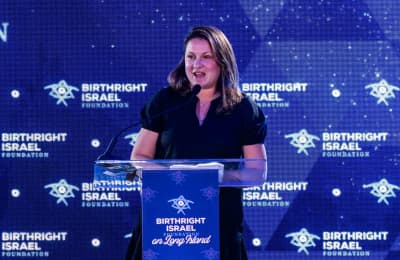
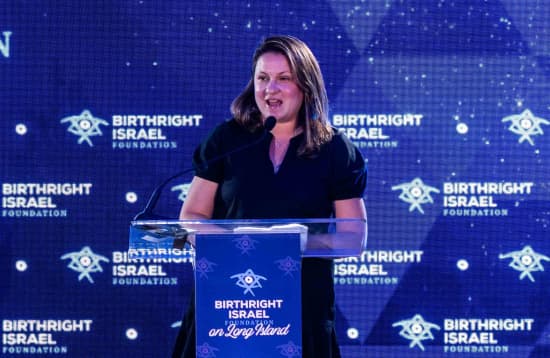
It was January of 2004, and I was nineteen years old, rolling my luggage out of Ben Gurion Airport for the first time. Something tumbled off the top. A young Israeli security guard bent down to pick it up. Our eyes locked, and the bells rang — at least for me. I looked at him and said, with all the boldness of a New Yorker: "God, you're beautiful." He didn't know what to do with me. His English wasn't great. I took his picture and told him he was my first sight in Israel and I needed to remember it forever.
Ten minutes later, he walked onto our bus and was introduced as our security guard for the trip. We've been married for almost seventeen years. We have three children. The girl sitting next to me on my Birthright Israel bus, when I first pointed him out, told me I was completely crazy. I told her: what if we're meant to be? I've always believed you're meant to be exactly where you are in any given moment. That trip proved it to me a hundred times over. But that love story, as good as it is, is not the whole story.
I grew up in a New York City housing project in Queens. My father was Puerto Rican, raised in Bedford-Stuyvesant, Brooklyn, educated until the age of fourteen. My mother was one of five children from a Hungarian Jewish family that carried enormous weight — my second cousins were identical twin survivors of Dr. Mengele's experiments. There are books written about them. Survival, perseverance, and a faith that somehow endured through all of it: that was the legacy on my mother's side.
My grandmother embodied that faith completely. She was a deeply pious woman who kept Shabbat, prayed constantly, and went to synagogue no matter what life threw at her. I lost her when I was fifteen, but the first time I stood at the Western Wall, I felt her right there beside me. Like she knew that I was going to be the one to carry forward my family's Jewish legacy.
I was not raised in a synagogue. I didn't go to Jewish summer camp or belong to a youth movement. I went to a public high school of thirty-seven hundred kids. And yet I always wore a chai or a Star of David. I couldn't entirely explain it. It was just always a part of me, even when I didn't have a community or a language to put around it. My father, who was an atheist, never made me feel strange about any of it. During Passover one year, he lined a shelf in his refrigerator with parchment paper and bought me a box of matzah. He said: this part is for you.
Israel was not somewhere I could go financially. It was simply out of reach for me, and for my mother. The first time she ever set foot in Israel was for my wedding. Without Birthright, there is no version of this story where I get on a plane to Israel at nineteen.
What Birthright gave me was a sense of place within the Jewish people, and with it, a sense of responsibility. I wasn't asked how Jewish I was, or which half. Everyone on my trip was different. Every background, every story, every shade of Jewish identity you could imagine. And all of it belonged to the same extraordinary narrative — the highs, the lows, the drama, the resilience, the humor. I could take everything I was, all that drive to show up and make things better, and pour it into the greatest story ever told. I've always described my Birthright trip as chapter one. That's what those ten days were for me.
When I got on the plane to fly home, I cried. I had fallen in love with a country. I had fallen in love with a person — though we weren't ready to say that out loud yet.
I spent my sophomore year of college at the Hebrew University of Jerusalem, where I also began working with StandWithUs on Diaspora education and took part in a student leadership course at Israel's Ministry of Foreign Affairs. These activities were the natural extension of the spark that Birthright had lit inside me. I made aliyah and lived in Israel for ten years. My eldest daughters were born in Jerusalem, which will always be my favorite city on earth — chaotic and ancient and completely alive in a way that always reminded me of the subway between Queens and Manhattan. I went on to serve as a senior shlicha at Hillel International, and then as director of the Israel Fellows program at the Jewish Agency for Israel, leading seventy-six Israeli emissaries across North American campuses, with then-chairman Isaac Herzog — now President of Israel — as my boss for two years. I soaked up every bit of that mentorship.
My sister reminds me regularly how much money I would have made if I had just gone to law school. She's not wrong about the math. But without those ten days in January of 2004, I would not be who I am. I would not have spent twenty years serving the Jewish people and Israel — as a speaker, an educator, an advocate helping young Jews navigate some of the most complex conversations of our time about Zionism, Jewish identity, and Israel engagement. I would not have been named one of the fifty most influential Jews in the world by The Jerusalem Post, or recognized as one of only six "Women to Watch" in the Jewish world, or included in The Tel Aviv Institute's Jewish 100 list of the most influential educators and leaders fighting hate. I am part of the Schusterman Foundation's ROI community for global Jewish leaders — a network I treasure because it is full of people who, like me, refused to accept that Jewish continuity was someone else's problem to solve. I would not have built a family that lives between two countries, two languages, and one improbable love story that started with a luggage cart at an airport.
I take it personally — deeply personally — that this gift exists. That a nineteen-year-old girl from a housing project in Queens, with no money and no synagogue and no summer camp in her past, can be handed a key that starts an engine she didn't know was inside her. Half of the American Jewish community now comes from interfaith backgrounds. There are so many young people carrying their identity quietly, without institutions or resources to help them explore it. I was one of them. I know what it meant to stand on that soil and be told, without a single word being spoken: you are part of this. The story belongs to you, too.
I like to believe I'm proof of what Birthright Israel can do. I hope I've given back enough to be worthy of it. But I know with absolute certainty that without Birthright, none of this happens. Not one chapter of it.