

June 11, 2026
Still Reaching Out Months After Birthright Israel
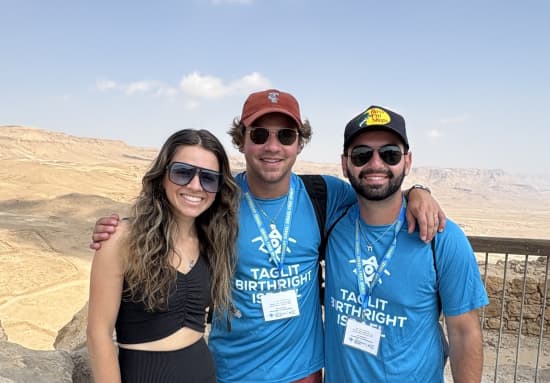
I think my words from our closing session, where our group looked back on our Birthright trip and said some emotional goodbyes, might be the best place to start in reflecting on the experience:
“I had the opportunity to come to Israel once before [with my Jewish Day School class], and when we had to leave, I was very sad, as I am today… And one of our Madrichim said to me at the airport, ‘Just know that you can reach out –– even if it’s been five years and we haven’t really spoken, you can still reach out.’ That was more than ten years ago, and we have kept in touch, and we actually got to see each other in person the day I landed back in Israel on this trip. I want to extend that same sentiment to everyone here –– even if it’s been a while, even if we don’t talk every day –– you can still reach out to me.”
After attending a Jewish Day School through eighth grade, I attended a public high school and then a large public university with a small Jewish population. Most of the friends I’d made since leaving middle school weren’t Jewish, and it wasn’t something I thought that much about.
However, after October 7th, I saw so many of the relationships I’d built throughout my life change or disappear; I hadn’t thought I needed Jewish friends before, but suddenly I felt so lonely in places where I used to think I belonged. I watched several of the people I’d once called my friends share anti-Semitic rhetoric and justify or even advocate for violence against my community –– sadly, an experience that’s become very common for Jews everywhere. I craved a sense of community where I could be unapologetically myself, including in my Judaism. And I felt like I found that on my Birthright trip.
You would’ve thought our Birthright group had spent much longer than ten days together from how close we were. I know that’s something people tend to say after all kinds of experiences making new friends, that it might not sound unique to this experience on the surface. But, almost nine months later, we’ve had multiple in-person reunions, with several of us getting together in various cities for Shabbats, a Passover Seder, and even a couple of weekends when half of the American participants from our group traveled from around the country to meet back up. And a big part of what has continued to sustain our connection has come from not only our shared Birthright experience but the shared Jewish values and sense of identity that it helped each of us discover or rediscover.

On the trip, it was easy for that connection and commitment to being there for one another to live in moments –– and those were sweet, memorable moments. There was a cup of tea offered to me on the bus when I woke up with a sore throat (probably from so much talking to get to know everyone and so little sleep, as I tried to make the most of each day). There was an extra hand in carrying bags, which had been stuffed since our visit to Shuk HaCarmel, down the streets of Jerusalem. There was (a great deal of) patience in teaching me Hebrew words and phrases. Part of why Birthright trips are so special is because they create an environment where that’s easy; it’s all planned out and organized, and there are structured spaces for meaningful dialogue with limited distractions.
But to witness that desire to maintain these friendships translating into real action and follow-through afterwards, when it was fully up to us and something we’d have to incorporate into the other parts of our lives we’d put on pause during the trip, was something rare and truly extraordinary. It’s something that, in a lot of ways, feels like the real-life integration of what we saw and experienced in Israel: connection between Jewish people sustaining through time and space when people truly commit to carrying it forward, not just in theory but in practice.
Knowing I’d remember the connection we shared as we prepared to part ways at the end of the trip, the feeling that made me express that anyone from the group could reach out to me even after time had passed, was special; actually sustaining that connection is something that has continued to teach me more and more about the strength of Jewish community that led me to Israel in the first place.
We had group discussions on the trip about what it means to be Jewish, debating which values and traditions we each consider most important to being Jewish. These conversations brought to light that while anyone with Jewish ancestry might be unquestionably Jewish, it has required (and continues to require) real effort and intention to carry Jewish beliefs, values, culture, and traditions forward.
Only looking back on these conversations with the knowledge of how the relationships from the trip have lasted can I see the common thread between that larger picture of Judaism over generations and this present-day microcosm: people making a conscious, consistent choice to stay connected, prioritize shared values, and continue fostering shared meaning, even when life gets busy and it’s not easy.
Those of us who have stayed in touch have supported each other through challenging times and shared many moments of Jewish joy, a contrast we recognized on the trip and one that is deeply ingrained in the very experience of being Jewish. Through our mutual understanding of that contrast and our shared desire to build from it, many of us have created and maintained bonds that have made those joyous times, like the reunions we’ve had, even more meaningful.
My Birthright trip and the relationships that have lasted from it –– and the ability to see what has allowed them to do so –– have added so much to my life, and I feel so incredibly grateful. I hope to return to Israel as soon as another opportunity arises, but in the meantime, I feel inspired and enlivened by the parts of Israel I feel like I’ve been able to incorporate into my life wherever I am.