

September 16, 2026
These Are the Trees They’ll See


Editors Note: On July 27, 2024, a Hezbollah rocket struck a soccer field in Majdal Shams, a Druze town in the Golan Heights, killing twelve children and wounding dozens more. In the two years since, Birthright Israel’s Volunteer in Israel program has partnered with the community to build gardens at local schools, an effort aimed at bringing renewal to spaces marked by loss. The reflections that follow come from volunteers who took part in that work.
My name is Illanna Shapiro, and I grew up in Flushing, Queens, though I live in Fair Lawn, New Jersey now. I’ve always felt close to Israel in a way I never separated from being Jewish. To me, Zionist meant Jewish. I still don’t think those are two different things.
I first went to Israel on Birthright at 19, through Hillel at my college in Arizona. Coming back as a volunteer was something else entirely. I’d always supported Israel from home, every fundraiser, every synagogue campaign, but doing something with my own hands made me feel strong and capable in a way that giving never had. The work matched what I was able to do, and the time flew. I made a whole new group of friends along the way.

Since October 7th, the first question anyone asks about going to Israel is whether it’s safe. There was only one day on the whole trip where we needed to know where the bomb shelter was. The Israelis we met were happy to see us in a way that stuck with me. They’d almost laugh, as if to say, what are you doing here, why would you come now, but you could tell how relieved and appreciative they really were.
During a geopolitical talk, they showed us footage of people marching across the Brooklyn Bridge back home, chanting about intifada, and I remember feeling ashamed of my own city watching it.
Before we ever reached Majdal Shams, we spent a day in Lod at a gemach—a donated goods shop—built in memory of a girl named Rena, killed in a terrorist attack at sixteen. More farm work followed, and that night we stayed by the Kinneret in Tiberias, which wouldn’t have been possible even just a year ago because of the security situation.
Originally, I’d only heard about Majdal Shams through Jewish news, and I knew the Druze mostly from a flag I’d once seen at the Israel Day Parade and had to look up. I didn’t realize we’d arrived at the school of the victims of the soccer field attack until we went inside and saw the memorials. What struck me most was how much it looked like my own kids’ elementary school, down to the artwork on the walls.
The principal came out to greet us, speaking in Hebrew while our guide translated. She told us that two hundred children were on the soccer field the day of the attack, and every one of them witnessed what happened to their friends. It happened too fast for many of them to reach safety in time, though she said Hezbollah has since been pushed farther back, giving the community more warning now than they had then. For the entire first year afterward, there were no real classes, just mental health support for the kids and guidance for the parents. Hearing that was eye-opening in a way I wasn’t ready for.
We planted a garden where there had been nothing before. Toward the end, the kids came outside to play, and we joined a parachute game, watching their faces light up. Someone in our group said something I keep coming back to: when these kids are daydreaming in class one day, looking out the window, these are the trees they’ll see, growing up alongside them. We were there four or five hours and could have stayed longer. With everything Israel has been through these past few years, it meant something to feel like we were helping, not just physically, but emotionally too.
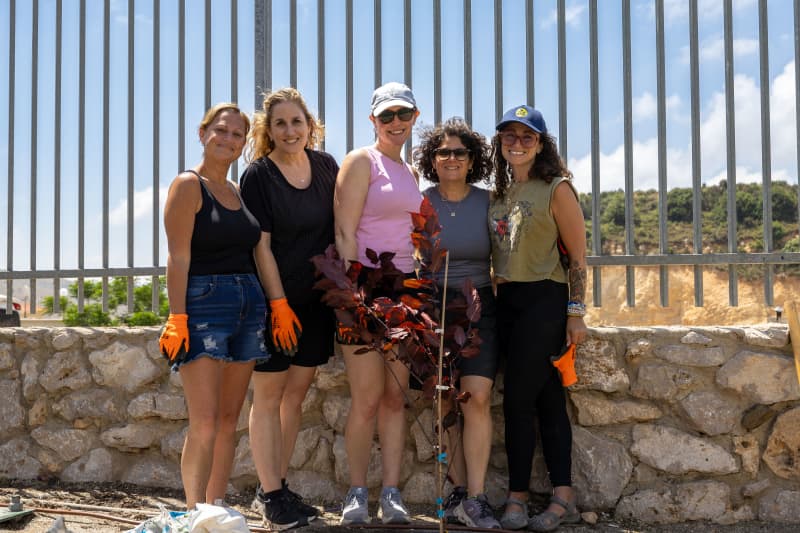
Back in the States, I go to Shabbat every week now, and I’ve come back thinking about making Aliyah more than ever before. To the donor who made this possible: the impact isn’t just on me. It’s on everyone I’ve told, everyone who’s seen my photos and said they learned something from them, everyone I’ve encouraged to go who otherwise wouldn’t have.
This trip made me realize the privilege we have here, not having to know that our teenagers will go into the army in a few years the way Israeli parents do. A few of us joked that we’d never plant a tree in our own backyard at home, but we were thrilled to do it there. I want to bring that spirit back, more volunteering, more ways to bring community service into my kids’ lives, maybe something we do as a family every month or quarter.